5 Whys Analysis Template: Free Download
Download a free 5 Whys template for documenting root cause analysis, corrective actions, and verification.

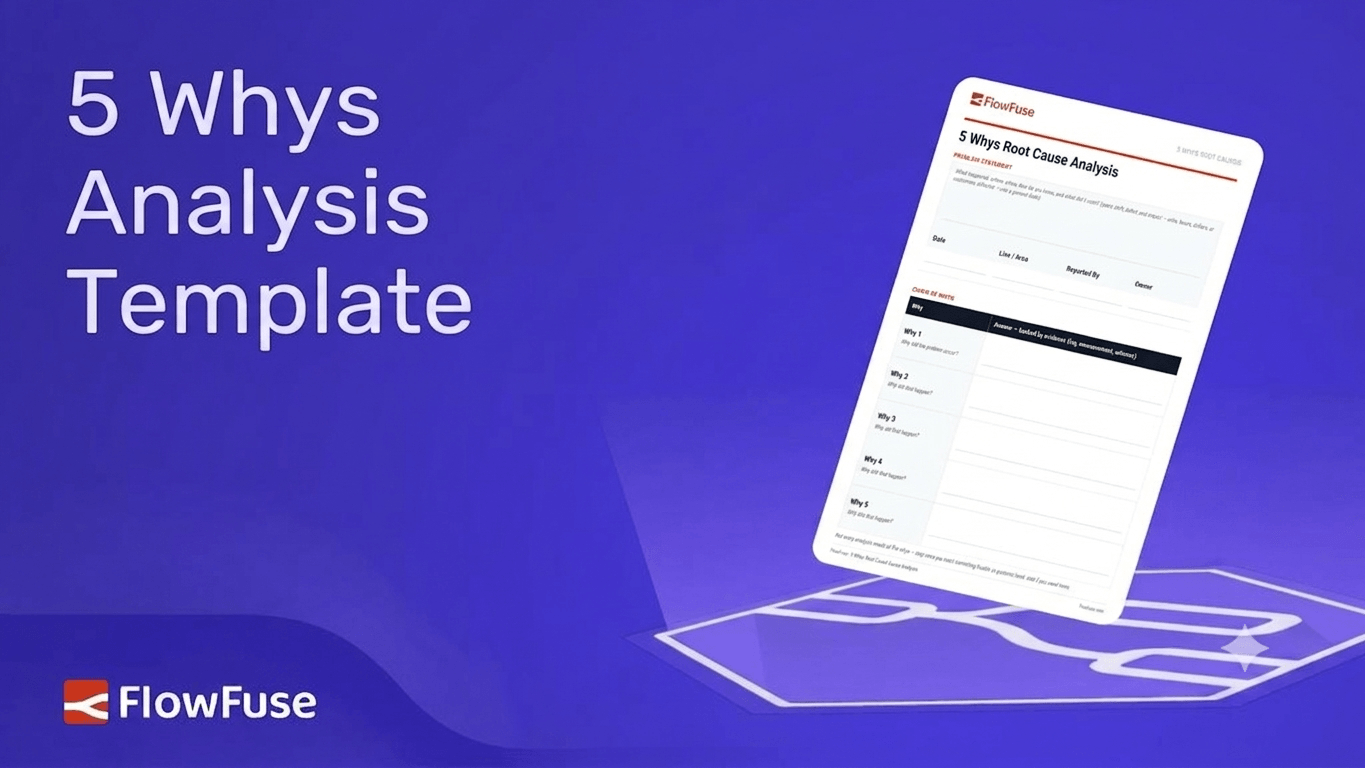
Download a free 5 Whys template to document problems, root causes, corrective actions, and verification.
A 5 Whys template gives your team a consistent structure to run a root cause analysis without missing a step or drifting into guesswork.
A good template keeps the analysis disciplined: one problem statement, one causal chain, evidence at every step, and a corrective action with an owner and a due date.
Download the free template below to give your team a consistent way to run a 5 Whys analysis and document it for corrective action tracking.
What Should Be on a 5 Whys Template?
A 5 Whys template only needs a few fields, each filled in with something you can verify rather than an assumption:
- Problem statement: What happened, where, when, and how you know it.
- Why 1–5 (as needed): Each answer builds on the one before it. Stop once you reach something fixable at a systemic level.
- Root cause: The systemic gap the chain of whys points to.
- Corrective action: The specific fix, an owner, and a due date.
- Verification: Confirmation, at a later date, that the fix actually held.
Not every analysis needs all five whys filled in, and some need more than five. The fields matter more than the count.
How to Fill In a 5 Whys Template
Each answer should be specific enough that someone reading it later, without having been in the room, understands exactly what was found.
| Avoid | Better |
|---|---|
| Operator error | The torque tool had not been recalibrated after its 90-day interval |
| Machine broke | The bearing seized from insufficient lubrication, confirmed by the oil flow log |
| Process issue | The work instruction was not updated after the March engineering change |
The goal is an answer that is objective and traceable to evidence (a log, a measurement, a witness), not a label that just restates the problem.
5 Whys Template Example
Consider a line that produced 40 rejected units during a single shift.
The team fills in the problem statement with the exact count, shift, and defect type rather than "quality issue on Line 3." Each why is answered with something checked on the floor, not a guess, until the chain reaches a worn sensor that was past its replacement interval. The corrective action gets an owner and a due date, and a follow-up entry on the template confirms the replacement held during the next production run.
The template makes this process repeatable across shifts and lines without each team reinventing the format.
Keep the Template Consistent, Not Complicated
A 5 Whys template should stay simple enough to fill out during the analysis itself, not after the fact from memory.
Resist adding fields for every possible category of information. If a template starts accumulating sign-off boxes, severity ratings, and cost fields beyond the owner and due date, it has drifted from a root cause tool into a different kind of form. Keep it to the problem, the chain of whys, the root cause, and the corrective action.
Connect Production Data to Corrective Actions
See how FlowFuse connects machine and process data with quality workflows so your team can track corrective actions and verify that fixes work.
About the Author
Sumit Shinde
Technical Writer
Sumit Shinde is a Technical Writer at FlowFuse specializing in industrial automation and manufacturing. In the past three years, he has built industrial applications and authored more than 100 technical articles covering industrial connectivity, unified data architecture, production metrics, and quality management for modern manufacturing.
Like what you're reading?
Add FlowFuse as a preferred sourceOn the page that opens, check the box next to flowfuse.com to see more of our articles in your Google Search results.
Related Articles:
- First Article Inspection (FAI): Process, Requirements & Report
- Layered Process Audit Checklist: Free Template and Examples
- VDA 6.3 Process Audits Explained: Structure, Scoring, and How to Prepare
- Control Plans: Linking Quality Characteristics to Measurement Data
- FlowFuse Dashboard 1.31.0: Five Themes for a Dark Mode Dashboard